Shakira becomes most liked celebrity on Facebook

Colombian singer sets record with 100 million followers, ahead of Eminem and Rihanna, who have 91.9 million and 89 million


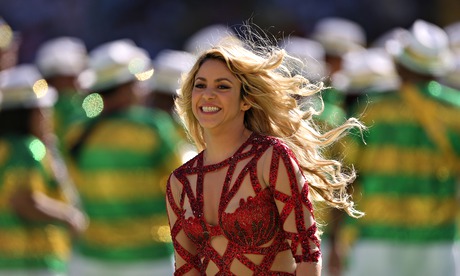
Shakira preforms during the closing ceremony during the 2014 World Cup final in Rio de Janeiro, Brazil. Photograph: Ian Macnicol/Getty Images

Shakira has become the first person to attract more than 100 million fans onFacebook, becoming the most "liked" celebrity on the social network in the process.

The Colombian singer, who recently performed at the closing ceremony of the 2014 World Cup in Brazil, stands ahead of Eminem and Rihanna, who have amassed 91.9 million and 89 million fans respectively.

The number of fans a person has on Facebook is measured by how many people have chosen to "like" their page and follow updates from it.

Shakira was particularly active on the social network during the World Cup, sharing a host of pictures from behind the scenes. Among them was a photograph of her standing on the field at the Maracanã stadium in Rio de Janeiro with a football at her feet, which became her most popular post on the site with more than 3.5m "likes".

She performed her World Cup-themed La la la (Brazil 2014) at the closing ceremony on 13 July.

In a statement posted on her Facebook page, Shakira said she was "honoured and humbled" to have reached the milestone. "Social media and specifically Facebook has helped myself and other artists bridge the gap between the stage and the audience," she said.

Facebook's founder and chief executive, Mark Zuckerberg, congratulated Shakira in a comment on her page. "Congrats! What an amazing milestone for an amazing person," he wrote.

Shakira's Facebook page is frequently updated with pictures and videos of her performing on stage, or at home with her boyfriend, the Spanish national footballer Gerard Piqué, and their son Milan.

She has had a number of global hits such as the 2006 "Hips Don't Lie" and has been a goodwill ambassador for Unicef since 2003.

Ten years after its creation, Facebook has more than a billion users worldwide.

Shakira: 'I know what I'm doing, even when I'm wearing a pencil skirt'

Shakira is not your average £26m pop star. She reveals why life is like a soccer field, why she's in therapy, and why she licked the bars of that cage.


Shakira ... 'The universe is so broad, I cannot be at the centre of it' Photograph: Capture Digital

In the lobby of the studio where Shakira is receiving the British press, there is a television tuned to a non-stop music video channel. For the most part, it appears to be engaged in a lengthy experiment to see how many times viewers can watch Pixie Lott's Mama Do video before suffering permanent damage to their cerebral cortex, but just before I'm called into the presence of the fourth richest woman in music (according to Forbes magazine), it shows the video for her new single, She Wolf.

This makes meeting Shakira a slightly disconcerting experience. It's not just that it feels strange politely shaking the hand of a woman you've just watched licking the bars of a cage with her thighs wrapped round her head. It's also quite hard to square said woman with the leotard-sporting figure being broadcast in the lobby. Shakira, as every interviewer is legally required to note, is tiny and pretty and softly spoken. She is dressed down and, unexpectedly, her nail varnish is black and hopelessly chipped, in the time-honoured manner of a teenage goth. The song and the video, she says, "are symbolic of the woman of our time who knows what she wants and defends her individual liberty with teeth and claws, who rebels against the limitations that society and our own culture places on her".

That's certainly one way of putting it, although, as quickly becomes clear, Shakira's way of putting things is noticeably different from other pop stars. Over the course of our meeting, she will quote Socrates ("a life without examination is a life that's not worth living"), openly discuss the fact that she's in therapy – "I just think that it's very helpful to have a map of your psyche, because when you have a map you know where to go" – and mention her love of Thomas Paine's 1791 abstract revolutionary political tract The Rights of Man. You don't have to have a panoply of journalistic experience to know that these are areas seldom covered in interviews with multi-platinum-selling pop stars, which usually cleave more to the gripping topics of (a) how truly blessed they feel, and (b) how grateful they are for their fans' support. In fairness, Shakira does some of the standard-issue stuff too – "if I can contribute to people having fun I would feel very fulfilled as an artist" – but you can tell her heart's not really in it by the way the conversation invariably heads off piste again within minutes: "Life is a soccer field, don't you think?"

Eliptical metaphors

Fans of her unfailingly peculiar lyrics will be delighted to learn that she talks rather like she sings, expressing herself through elliptical metaphors. She says she started seeing a shrink eight years ago, because she couldn't work out "whether the horse was guiding the jockey or the jockey was riding the horse" (noting my slightly confused expression, she adds firmly: "it should be the latter"). It's utterly charming, and you get what she's driving at, but it does leave the mind boggling a little at precisely how last year's much-vaunted telephone conversation between Shakira and Gordon Brown panned out: you rather picture the prime minster holding the phone away from his ear and pulling WTF? faces at his spin doctors. Then again, perhaps not. The conversation was about her charity work in the field of educating underprivileged children in Latin America – the Pies Descalzos [Bare Feet] foundation she started at 19 and named after her third album has provided education and jobs to 30,000 Colombians, and when Shakira gets on to the subject of her charity work, the more airy metaphors vanish in favour of a torrent of statistics: 35 million children in Latin America don't receive access to education of any kind, 300 million worldwide don't attend school, one year of primary schooling can increase a person's salary by between 10% and 20%. There's an impressive steeliness in her manner that presumably stands her in good stead when glad-handing the world's politicians. No, she says, she's not overly concerned with politicians using her for a youth vote-grabbing photo op and then ignoring her demands. "They don't get the photo op if they don't commit to something. That's how it works with me." She pauses, apparently searching her bottomless supply of peculiar phrases. "I know what I'm doing even when I'm wearing a pencil skirt."

She says she studied writing lyrics in English "when I could barely speak the language", with the aid not merely of a dictionary, but the collected works of Bob Dylan, Leonard Cohen and Walt Whitman (needless to say, these are names that seldom come up in interviews with multi-platinum selling pop stars). "It was probably one of the most important challenges of my life," she says. "I feel like I was thrown in a pool without learning to swim and I didn't drown." Nevertheless, there's a slightly patronising assumption that her more abstruse lyrics – She Wolf's "I'm starting to feel a little abused like a coffee machine in an office", or the deathless line from her English-language breakthrough hit Whenever, Wherever about how lucky she is that her "breasts are small and humble so you don't confuse them with mountains" – are the cack-handed efforts of a woman struggling to express herself in a language she doesn't entirely grasp. They aren't: if you listen to the version of Whenever, Wherever recorded for the Latin American market, the stuff about her breasts is present and correct: "Suerte que mis pechos sean pequeños, y no los confundas con montañas," should you ever wish to discuss Shakira's bosom in Bogotá. Similarly, she's much given to hitting journalists with a slightly elliptical metaphor when being interviewed in her mother tongue, as when her hometown of Barranquilla unveiled a six-tonne metal statue of her. "Barranquilla is a big breast," she told the assembled media, "that fed and nurtured me as a human being." It's clearly nothing to do with language barriers: her English is superb. Shakira just has a unique way with words.

'I got addicted to being on stage'

But almost everything about Shakira is unique. Her press pack reveals a woman who has in recent years been interviewed by FHM magazine, which wanted to talk about whether or not she'd ever consider a boob job, and The Economist, which didn't, preferring to concentrate on her views on the globalisation of the music industry. She says her philanthropy has its roots in an odd incident in her childhood when her recently bankrupted father took her to a park to see the local glue sniffers in an attempt to convince her that there were people substantially worse off than them. Meanwhile, her path to stardom is again different from the average pop superstar's route. She apparently decided fame was to be her lot at the age of four, following an epiphany involving a belly dancer gyrating to the sound of a Arabic drum called a doumbek during a visit to a restaurant with her Lebanese father. Within a year, she was "dancing and doing performances in school, every Friday, the same number over and over again. I was five years old, I got addicted to being on stage, it felt like it was the most wonderful place on Earth, performing in front of an audience, who in this case were a bunch of classmates, kids my age."

Quite what said classmates made of being subjected to Shakira performing the same song over and over again on a weekly basis is unrecorded, but the school choirmaster was definitely unimpressed: "He thought I had a pronounced vibrato. He said I sounded like a goat and I would destabilise the entire choir if I was allowed to join." At least her parents were supportive of a drive that, she notes, "was more like a compulsion" than a mere ambition. "At the age of eight I discovered that I could write songs. My dad used to take them to the notary and register them so that nobody could steal them from me. Who does that? What parent takes a treasure in his child's scribbles?"

They also took to ferrying her around a bizarre selection of gigs in Barranquilla, including a series of shows for mine workers. "I would sing anywhere they would invite me," she says airily, as if a 10-year-old girl singing and dancing for the edification of a load of miners is the most normal thing in the world. "That's how I made my first pesos. I used to sing at beauty pageants, local events of every sort." By the time she was 14, she had a record deal, having tracked a label executive down to his hotel room and where she performed with a boombox. But her career didn't take off – there wasn't much of an indigenous pop scene in Colombia – and at 17, her record label threatened her with the chop: "Before my third album, they warned me that if nothing really happened, they were going to drop me. I knew it was my last chance, so I took control. I started to get more involved with production. I started to use my own influences. My music was influenced more by the Anglo-Saxons than the local tropical or Latin roots. When I was singing in Spanish, I had a more rock'n'roll attitude. I was very inflexible, very rigid in many aspects. There were things that would be completely unacceptable to me, like wearing a leotard, or showing my legs." She laughs. "I was more of a purist then."

Even without the aid of a leotard, the subsequent album sold 5m copies in Latin America alone. Its follow-up, the English-language Laundry Service, sold 13m copies. "After that, the artist can set the rules," she nods, which, in her case, means making deeply idiosyncratic musical choices – her 2006 album Oral Fixation Vol 2 variously featured mock-Gregorian chanting, elephant sound effects, Britpop oompah, a children's choir and a Led Zeppelin pastiche – and equally idiosyncratic career moves: after touring the Oral Fixation album, she declined to start work on a follow-up, preferring instead to don a disguise and study history at UCLA. "It was such a long tour, I needed a break from me. The universe is so broad, I cannot be at the centre of it. So I decided to go to the university and study history for a summer course, just to kind of switch gears, taste the student life. I used to wear a cap and a big backpack, I looked like a boy. I didn't get recognised. Some people looked at me very suspiciously, a few people asked me, but I told them my name was Isabelle. I would go to university over and over again if I could."

But for now, there's the new album to promote, journalists queuing outside the door to interview her, then another world tour. She says fame is "pretty much" everything she thought it would be when she was four. "I can't complain. I come from a city in Colombia that most people have never even heard of. When I look back, I can't believe the path behind me. I always feel like I haven't really done anything."

She's said a lot of strange things this evening, but that seems a particularly odd remark, given the record sales and the charity work, the estimated fortune of £26m. She nods. "I should care less. It's been 20 years, but I still care about my career. I care about the music." She shakes her head. "I'm not normal," she adds, a little superfluously.

Shakira Colombian musician

Shakira, in full Shakira Isabel Mebarak Ripoll   (born February 2, 1977, Barranquilla, Colombia), Colombian musician who achieved success in both Spanish- and English-speaking markets and by the early 2000s was one of the most successful Latin American recording artists.
Shakira, who had a Lebanese father and a native Colombian mother, started belly dancing at an early age and by age 10 had begun writing songs and taking part in talent competitions. A local theatre producer helped her land an audition with a Sony Corp. executive in 1990, and Shakira was subsequently signed to a record deal. Her first two albums, Magia (1991) and Peligro (1993), were only moderately successful, however. After taking a break from recording to act in the Latin soap opera El oasis, Shakira resumed her music career in impressive fashion with Pies descalzos (1995). The album produced several hits, including “Estoy aquí,” “Pienso en ti,” and “Un poco de amor.
After releasing ¿Dónde están los ladrones? in 1998, Shakira focused her efforts on establishing herself in the American market. In 2001 her album MTV Unplugged (2000) won the Grammy Award for best Latin pop album, and she released her first English-language album, Laundry Service, that same year. Although her English-language songwriting skills were questioned by some (Shakira wrote all her own lyrics), Laundry Service sold more than 13 million copies worldwide.
Shakira continued her crossover success in 2005 with the release of the Spanish-language Fijación oral, vol. 1 in June and the English-language Oral Fixation, Vol. 2 in November. Both albums debuted in the top five in the United States, and her single “Hips Don’t Lie” (featuring Wyclef Jean) topped charts around the world in 2006. At that year’s Latin Grammy Awards, she captured song-of-the-year and record-of-the-year awards for the single “La tortura,” and Fijación oral, vol. 1 was named album of the year as well as best female pop vocal album. A live recording, Oral Fixation Tour, followed in 2007. Also that year Shakira performed in Hamburg as part of Live Earth, a worldwide concert series organized to bring attention to climate change and environmental sustainability.
For her next English-language album, She Wolf (2009), Shakira adopted an electro-pop sound. The following year she scored another international hit with “Waka Waka (This Time for Africa),” a collaboration with a South African band, after it was chosen as the official anthem of the 2010 World Cup. The track later appeared on her breezily eclectic Sale el sol (2010), which earned a Latin Grammy for best female pop vocal album. In 2013 Shakira became a coach on the American televised singing competition The Voice.
Shakira devoted considerable time and energy to social causes. In 2003 she became a UNICEF goodwill ambassador, traveling internationally to raise awareness of the struggles of children in less-developed countries. She also created the Pies Descalzos Foundation, which focused on helping children displaced by violence in Colombia.

Ricky Martin, Jennifer Lopez, Shakira & More in HBO's 'The Latin Explosion': Watch First Trailer

Ricky Martin in the trailer for the HBO Documentary "The Latin Explosion: A New America."

10 Landmark Moments on Billboard’s Latin Charts – From Shakira’s ‘La Tortura’ to Enrique’s ‘Bailando’
HBO is bringing out seemingly every A-lister in the book for its upcoming Latin music special The Latin Explosion, which will chart the history and cultural impact of Latin artists in the U.S. going back to the 1950s.
The first trailer, out now, opens with Mr. “Livin’ the Vida Loca” himself, Ricky Martin, pointing out that “the U.S. is the second-largest Spanish-speaking country in the world” to images of Romeo Santos and Pitbull performing for sold-out stadiums, and including Marc Anthony’s “Vivir Mi Vida.”  Adding a “Boom!” for effect, Martin’s soundbite segues into an interview with Jennifer Lopez. “It’s our time,” she says, seconds before Gloria Estefan chimes in, reminiscing on the times when record label execs asked her to change her name because it was “too difficult to pronounce.”
How times have changed. But as The Latin Explosion aims to show, Latinos’ lasting impact on American culture goes beyond entertainment. Aside from Latin music superstars, in the trailer we see images of Supreme Court Justice Sonia Sotomayor and hear from Hollywood powerhouse/activist Eva Longoria.
John Leguizamo narrates the doc, executive produced by Tommy Mottola and also featuring José Feliciano, George Lopez, Rita Moreno, Shakira, Thalía, Sofía Vergara and more. Enrique Iglesias, however, is noticeably absent. 

'Love' & Games: Shakira Opens Up About 'Love Rocks' Mobile Game & Love of Her Life Gerard Pique

Shakira for Love Rocks.
COURTESY OF LOVE ROCKS

"I've played his, and he’s played mine," she jokes of Pique's soccer game.

Shakira says she’s always liked games, but in moderation.

“I have two kids, a career and a man that takes a lot of my attention and time,” the Colombian star told Billboard.
Even so, she couldn’t resist the lure of creating her own game, especially after playing hubby Gerard Pique’s own fantasy soccer game, which, she says, is “very, very good.”
Now, Piqué is getting to play Shakira’s Love Rocks, which launched Thursday (Oct. 15) through Angry Birds game maker Rovio and is available for Android and Apple.
Love Rocks features love, jewels and treks through exotic locales handpicked by Shakira. And, of course, it features Shakira’s music.
"Love Rocks" starring Shakira.
"Love Rocks" starring Shakira.Courtesy Photo
The first three “worlds” in the game -- with more to be added continuously -- are Barcelona, Taj Mahal and El Dorado, the mythical city of gold in Shakira’s native Colombia.
Shakira has a personal connection to all the locales, beginning with Barcelona, the city where she currently lives and where her romance with Piqué started. The fact that the song tied to this first Barcelona “world” is “Loca” (Crazy), is no coincidence, as she filmed the song’s video in the city.
“It was a crazy video where we didn’t even ask for permits,” she laughs. “I rode a motorcycle without a helmet on, I got fined for that, I ended up dancing in a public fountain. I was a little crazy then, because I had just met Gerard and I was falling in love madly and I was kind of losing it. So that’s why that video is an explosion of happiness and that’s why ‘Loca’ is the first song.”
The Taj Mahal -- the second world -- is tied to the Middle Eastern-sounding “Ojos Así,” while the third, El Dorado, is tied to “Wherever, Whenever,” which features Andean flute.
While Shakira says she spent a good chunk of time readapting and reinterpreting her music for the gaming space, Love Rocks' historical and mythological references were also important to her as a self-proclaimed history buff.
Take the legend of El Dorado, where an Indian chief covers himself in gold dust and precious jewels during a ceremony in Lake Guatavita. “The myth says there’s still some treasure buried in the lake,” Shakira says. “And it all has to do with the theme of rocks. I think the mythological is so colorful. It just adds to everything. And in today’s world, fantasy is a little displaced, so it’s always fun when you can do things creatively.”
While Love Rocks couldn’t be any more different from Piqué’s soccer game, soccer is what made the app possible.
It began when Piqué invited Peter Vesterbacka -- Rovio’s Mighty Eagle (yes, that’s his title) and the man behind the Angry Birds games -- to a soccer match. Shakira also went, “and after five minutes, we decided we wanted to do a game together,” she recalls. “Peter is very passionate about education and early education, and this is a passion of mine as well, to advocate for universal access to education. We got talking about that first and hit it off so well, we decided to create a game together."
~ My new game, Love Rocks Starring Shakira, is finally here! It’s awesome - hope you love it as much as I do! http://rov.io/LoveRocks Shak~ Mi nuevo juego, Love Rocks Starring Shakira, ya esta aquí! Esta genial - espero que los disfruten tanto como yo! http://rov.io/LoveRocks Shak
Shakira says she and Vesterbacka have plans to also collaborate on early childhood projects. Meantime, while Love Rocks was in development, Rovio hinted at what was to come by launching a Shakira Angry Bird (the Shakira Bird), an adorable yellow bird with long, blond tresses.
“Of course it’s cute!” quips Shakira. “I approved it!”
As to what gets played in the Shakira-Piqué household, “I’ve played his, and he’s played mine,” says Shakira with a laugh. “But I think he’s better at soccer.”

Shakira Biography

Born and raised in Barranquilla, Colombia, Shakira is a hugely popular Colombian pop singer who is known for the hits "Whenever, Wherever" and "Hips Don't Lie."

“Sometimes I look at my reflection and I see garbage and I guess I was worried about the size of my breasts for a long time but now I think I have finally reached an age where I have accepted myself for who I am.”

Shakira - Mini Biography (TV-PG; 2:07) International pop singer Shakira won several several Latin music awards and brought her superstar success overseas with songs like "Hips Don't Lie." She continued to expand her celebrity status as a judge on the show "The Voice."
Synopsis

Born in Colombia on February 2, 1977, hugely successfully Colombian pop singer and dancer Shakira has won two Grammy Awards, seven Latin Grammy Awards and 12 Billboard Latin Music Awards, and has been nominated for a Golden Globe Award. Known for hits like "Whenever, Wherever" and "Hips Don't Lie," Shakira is the highest-selling Colombian artist of all time, and the second most successful female Latin singer after Gloria Estefan. By 2012, her U.S. album sales had reached nearly 10 million.


Early Life and Career

Shakira Isabel Mebarak Ripoll was born on February 2, 1977, in Barranquilla, Colombia. With a Lebanese father and Colombian mother, Shakira honors both her Latino and Arabic heritage in her music. She wrote her first song at the age of 8 and signed her first record deal at 13.

After her first two albums flopped, Shakira took the reins of her third album, becoming involved in every aspect of its production. Released in 1996, Pies Descalzos, meaning "bare feet," sold more than 3 million copies. The album featured her trademark sound, a blend of Latin, rock and Arabic musical styles. Her follow-up record, Dónde Están Los Ladrones? (1998), which translates as "Where are the thieves?", reached the top of Billboard's Latin charts. Not long after, Shakira won her first Grammy Award (best Latin pop album) for Shakira: MTV Unplugged (2000).

With the success of her albums, Shakira became a music superstar in the Spanish-language markets, known for her strong vocals and incredible hip-shaking belly dance moves.

While hugely popular throughout much of the rest of the world, Shakira had not yet achieved a major record on the U.S. pop charts. In an attempt to increase her American fan base, in 1997, at the age of 20, the singer moved with her family to Miami, Florida, and taught herself to write songs in English. There, she enlisted Emilio Estefan, of Gloria Estefan and the Miami Sound Machine fame, to act as her manager and producer.

In 2001, Shakira released her first English-language album, Laundry Service, which quickly brought her the success in the United States she had been waiting for. The album reached No. 3 on the charts, selling more than 200,000 copies in its first week of release. Laundry Service's big hits included "Whenever, Wherever" and "Underneath Your Clothes."

Shakira returned to the Top 10 of the albums chart twice in 2005. She released the Spanish-language Fijación Oral, Vol. 1 in June of that year, followed by the English-language Oral Fixation, Vol. 2 in November. Fijación Oral, Vol. 1 garnered Shakira her second Grammy, this time for best Latin rock/alternative album.

Touring extensively, Shakira went on to release two concert albums: 2007'sLive and 2008's Oral Fixation Tour. In July 2009, she put out a new single, "She Wolf," from her studio album of the same name. The album hit No. 15 on the Billboard charts in 2009, and went platinum in 2010. Around the same time, her hit "Waka Waka" from 2010's Sale el Sol became the theme song for the 2010 FIFA World Cup. Shortly thereafter, the now-global superstar headed on tour to promote her album.

By 2012, Shakira's U.S. album sales had reached nearly 10 million and her worldwide album sales had reached more than 70 million. She is the highest-selling Colombian artist of all time, and the second most successful female Latin singer after Gloria Estefan. In March 2014, Shakira released a self-titled studio album. The album includes a song with Voice co-star and country singer Blake Shelton. The same year, she took her signature grooves to the global stage again when she closed out the 2014 FIFA World Cup in Brazil.

In late 2012, Shakira was confirmed as a judge/coach on NBC's popular singing-competition show The Voice. Along with R&B singer-songwriter Usher, Shakira made her Voice debut on the show's season 4 premiere, which aired on March 25, 2013. Replacing Christina Aguilera and Cee Lo Green, Shakira and Usher joined returning judges/coaches Adam Levine and Blake Shelton. "Usher and Shakira are coming into it as a big frickin' institution," Levine said in late 2012, according to The Huffington Post. "So it's different, but it still feels good, because they're legitimate artists."

Shakira quickly became popular with TV audiences. Both she and Usher were not part of the show's fifth season, however. Christina Aguilera and Cee Lo Green returned for that season. She and Usher made their return to the panel in season 6 of The Voice.

Outside of her busy career, Shakira created the Pies Descalzos Foundation to help children in her native Colombia receive a quality education. She is also a UNICEF Goodwill Ambassador, and was honored by the United Nations' International Labor Organization for her philanthrophic efforts in 2010.

I always ask myself, what was the real purpose to my life? I always knew it was not to shake it endlessly, you know what I mean?

Shakira is in a relationship with Spanish soccer player Gerard Piqué. The couple welcomed their first child together on January 22, 2013. They named their son Milan, which means "dear, loving and gracious" in Slavic; "eager and laborious" in Ancient Roman; and "unification" in Sanskrit, according to a statement on Shakira's website. In August 2014, the couple announced she was pregnant again. Their second son was born on January 29, 2015.

Shakira previously dated Antonio de la Rua, son of former Argentine President Fernando de la Rua. In April 2013, de la Rua made headlines when he sued the Latin songstress for $250 million, charging that he had helped create some of his ex's hit songs as well as the "Shakira brand."

Shakira

Singer, songwriter
Achild prodigy and a star throughout the Spanish-speaking world, the Colombian vocalist Shakira made a successful crossover to English-language pop with her 2001 album Laundry Service. Shakira's camera-friendly looks and carefully controlled image concealed both a creative artist who wrote most of her own material and an astute businesswoman who became an international star without alienating her original Latin American fan base. After a hiatus of several years, usually the kiss of death for a career in the fast-moving world of pop, Shakira re-emerged bigger than ever with double releases in 2005, Fijación Oral, Vol. 1 and Oral Fixation, Vol. 2.
Born Shakira Isabel Mebarak Ripoll on February 2, 1977 (some sources give February 9 as her birthday), in Barranquilla on Colombia's Caribbean coast, Shakira is the daughter of a Colombian mother and a Lebanese father. The Arabic background of her father, a writer and jeweler, greatly influenced young Shakira, as can be heard in some of the songs she has written. In Arabic, her first name means "woman full of grace," and it is how she has chosen to be known professionally. While still quite young, she showed a love for music and a talent her parents considered quite remarkable in a child so young. She entered a number of local and national talent and beauty contests, and by the time she was ten years old she had won several.
At the age of 13 Shakira left Barranquilla for Colombia's capital of Bogota to take a modeling job. The modeling job never materialized, but perhaps it was for the best. Instead she signed her first recording contract with Sony Music Colombia, and soon released her first album. TitledMagia, Shakira's debut was made up entirely of songs that she had written between the ages of 8 and 13. Although the album never achieved great success, it did bring the young songstress to the attention of her country and led eventually to her selection to represent Colombia at the annual Festival OTI, scheduled to be held that year in Spain. Her participation in the festival was barred at the last moment when officials realized that she was under the minimum age of 16.
At age 15 Shakira graduated from high school. Shortly thereafter she released her second album,Peligro, which failed to win much more attention than her debut effort. Soon after the disappointing release of Peligro, Shakira signed on as an actress in the Colombia television soap opera El Oasís, and remained with the cast for about a year before returning to her musical career.
Shakira's breakthrough came with the 1996 release of Pies Descalzos (Bare Feet), an album that has sold more than four million copies worldwide and one that produced no fewer than six smash singles. At first, sales were disappointingly slow. Several months after the album went on sale, "Estoy Aquí," the first single to be released, caught fire with disc jockeys at radio stations throughout the Spanish-speaking world, and the single soon made its way to number one on the Latin charts. This feat that was later matched by the follow-up single "Dónde Estás Corazon?." Four other singles from the album—"Antologia," "Pienso en Ti," "Un Poco de Amor," and "Se Quiere, Se Mata"—reached the top ten on the Latin charts. The album itself managed to hit number one in sales in eight different countries. So popular was Pies Descalzos in Brazil, where sales topped 900,000, that Shakira recorded remixes of several songs in Portuguese.
What made Shakira's success with Pies Descalzos all the more impressive was the singer's decision to abandon her light pop format and establish for herself a distinctive and somewhat daring new style—a distinctive blend of pop and rock unlike anything being done by Colombian singers at the time. To get the album done the way she wanted, she had to overrule her label's recommendation that she stick to a format with more commercial appeal.
In support of Pies Descalzos, Shakira toured widely throughout the Spanish-speaking world, including cities in the United States with large Hispanic populations. The album and tours helped to make her one of the most visible musical performers in Latin music. Her tours crisscrossed the globe and lasted nearly two years.
After the phenomenal success of Pies Descalzos, the big question for Shakira, her recording label, and the critics was whether she could produce a comparable hit her next time out. Ably assisted by record producer Emilio Estefan, husband of Cuban-born singer Gloria Estefan, Shakira released Dónde Están los Ladrones? (Where are the Thieves?) in 1998. Critics hailed the spirit and integrity of Shakira's music, showcased beautifully by the high production standards for which Estefan is known. Of her work on Ladrones, Shakira said: "My music is sincere, everyday music. It is music that stems from a completely genuine source."
Critics hailed Dónde Están los Ladrones? as a breakthrough album for Shakira. Its title track was a none-too-veiled reference to the corruption found at all levels in her native country. One of the first big singles from the album was "Ojos Así," which roughly translates as "Those Eyes." In it one can hear some of the Arab influences that are so dear to Shakira's heart, blended skillfully with the best of Western pop. Estefan was full of praise for Shakira. "It is totally refreshing for me to work with an artist who knows exactly what she wants, both at a musical and a personal level," he said. "Her music is Shakira. It's real music." Even Shakira seemed genuinely pleased with the album. Speaking to an interviewer for Time International, she said all the album's tracks have a "real, organic sound. The whole core is rock, even the dance songs."
During the summer of 1999 the MTV Network, which broadcasts in markets around the world, including much of Latin America, taped Shakira in one of its MTV Unplugged concerts. Performing in the Grand Ballroom of MTV's Manhattan Center Studios in New York City, the Colombian singer sang almost all of the songs for which she had become well known. MTV's editors then distilled the taped footage into an hour-long program that focused on the most important and influential songs of her repertoire. Beginning in 2000 the program was aired throughout Latin America as well as in the United States. An album of the songs performed on the hour-long show was also released in 2000.

For the Record …

Born Shakira Isabel Mebarak Ripoll on February 9, 1977, in Barranquilla, Colombia.
Moved to Bogota, Colombia, at the age of 13 to model but ended up instead with a recording contract for Sony; released debut album, Magia, 1991; released Peligro, 1994; acted on Colombian soap opera El Oasis, 1994; returned to recording music, 1995; released Pies Descalzos, 1996; released Los Dónde Están Ladrones?, 1998; released MTV Unplugged, 2000; released English-language debut, Laundry Service, 2001; released Live & Off the Record, 2004; released Fijación Oral, Vol. 1, Oral Fixation, Vol. 2, and enhanced album Tortura recorded with Alejandro Sanchez, 2005.
Awards: Three Latin Grammy Awards, for Best Female Pop Vocal Performance, for "Ojos Así" from MTV Unplugged, 2000; for Best Female Rock Vocal Performance, for "Octavo Día" from MTV Unplugged, 2000; and for Best Latin Rock/Alternative Album, for Fijación Oral, Vol. 1, 2005; American Music Award for favorite Latin artist, 2005; six Latin Music Awards for single "La Tortura" (The Torture), with Alejandro Sanz, 2006.
Addresses: Record company—Sony Music Latin America, 605 Lincoln Rd., Miami Beach, FL 33139.Website—Shakira Official Website: http://www.shakira.com.
At the first Latin Grammy Awards in September of 2000, Shakira won Grammys for Best Female Pop Vocal Performance for "Ojos Así" and for Best Female Rock Vocal Performance for "Octavo Día." She also performed at the awards show. Only a week earlier she had won an MTV Video Music Award for her video of "Ojos Así." News of the Grammy Awards gave a big lift to sales of Shakira's albums. In the weeks immediately following the awards ceremony, sales shot up by as much as 30 to 40 percent in the Los Angeles metropolitan area, one of the major Latin music markets in the United States.
Estefan told Entertainment Weekly in 2000 that he fully expected Shakira to be the next big Latin crossover star, creating a sensation on the same scale as Selena or Ricky Martin. He further predicted that "Middle Eastern combined with Latin music is the next big sound." Of her work on her new English-language album, Shakira said: "I'm working day and night writing, but I'm also taking my time. I want this album to put a big smile on my face."
And so it did, selling an estimated 13 million copies worldwide. Shakira won the admiration of even the dean of South American writers, Colombian novelist Gabriel García Márquez, who (according to the Economist) praised the "innocent sensuality" of her music. In the important U.S. market, Laundry Service rose to the number three spot on Billboard's album sales ranking, thanks to the hit singles "Whenever, Wherever" and "Underneath Your Clothes." Shakira studied English intensively and as usual wrote much of the music herself.
The expected industry strategy would have been to rush a second English album to completion quickly and release it to raise the artist's profile still further. Shakira had other ideas. Determined to keep control over her own music, she took a long break after finishing worldwide touring in support of Laundry Service. Her label Sony filled the gap with the album and DVD Live & Off the Record in 2004 while Shakira wrote new material. That material fell into groups of Spanish and English songs. Now based in Miami, Shakira was determined not to lose her connection to Spanish-speaking fans in Central and South America. So she took the unusual step of releasing two linked albums, one after the other. Fijación Oral, Vol. 1 and Oral Fixation, Vol. 2 both appeared in 2005, featuring the singer's catchy mix of Latin rock, pop, and world music sounds spiced by high-powered guest talent.
An early indication of the success of Shakira's success came when Fijación Oral, Vol. 1 became a hit in European markets with few Spanish speakers, such as Germany, Finland, and France. Critical reception for the English album was mixed. David Browne of Entertainment Weekly wrote that "for all the musical ingredients at her disposal, Shakira winds up with a relatively bland dish," while Stephen Thomas Erlewine of All Music Guide was impressed that "it's a deadly serious, ambitious pop/rock album, most assuredly not frivolous dance-pop." The album reached number five on Billboard's Top 200 album list (one step below Fijación Oral, Vol. 1), and the singles "La Tortura" and "Hips Don't Lie" kept Shakira on radio airwaves and music playlists across much of the world through 2006. By that time Shakira was, as an Economistwriter quipped, Colombia's greatest legal export.

Selected discography

Magia, Sony, 1991.
Peligro, Sony, 1994.
Pies Descalzos, Sony, 1996.
Dónde Están los Ladrones?, Sony, 1998.
Shakira, MTV Unplugged, Sony, 2000.
Laundry Service, Sony, 2001.
Live & Off the Record, Sony, 2004.
Fijación Oral, Vol. 1, Epic, 2005_
Oral Fixation, Vol. 2, Epic, 2005.

Sources

Periodicals

Economist (U.S.), July 23, 2005, p. 62US.
Entertainment Weekly, September 29, 2000, p. 129; December 2, 2005, p. 79.
Hispanic, March 31, 1999, p. 75.
Interview, August 2002, p. 113.
People, June 13, 2005, p. 43; December 19, 2005, p. 93.
Teen People, May 2006, p. 52.
Time, February 15, 1999, p. 80; March 15, 2004, p. 99.
Time International, August 3, 1998, p. 36.

Online

"Biography," Shakira: MTV Unplugged, http://www.shakira.com/main.html (May 8, 2001).
"International Beat: Shakira, Celia Cruz, Ricky Martin," Sonicnet.com, http://www.sonicnet.com (May 8, 2001).
"International Beat: Valerie Belinga, Shakira, Gloria Trevi," Sonicnet.com, http://www.sonicnet.com (May 8, 2001).
"Latin Grammys' Fallout: Increased Sales, Lingering Controversy," Sonicnet.com, http://www.sonicnet.com (May 8, 2001).
"Review: Shakira Returns to U.S.," Sonicnet.com, http://www.sonicnet.com (May 8, 2001).
"Shakira," All Music Guide, http://allmusic.com (July 15, 2006).
"Shakira: Biography," Sonicnet.com, http://www.sonicnet.com (May 7, 2001).